
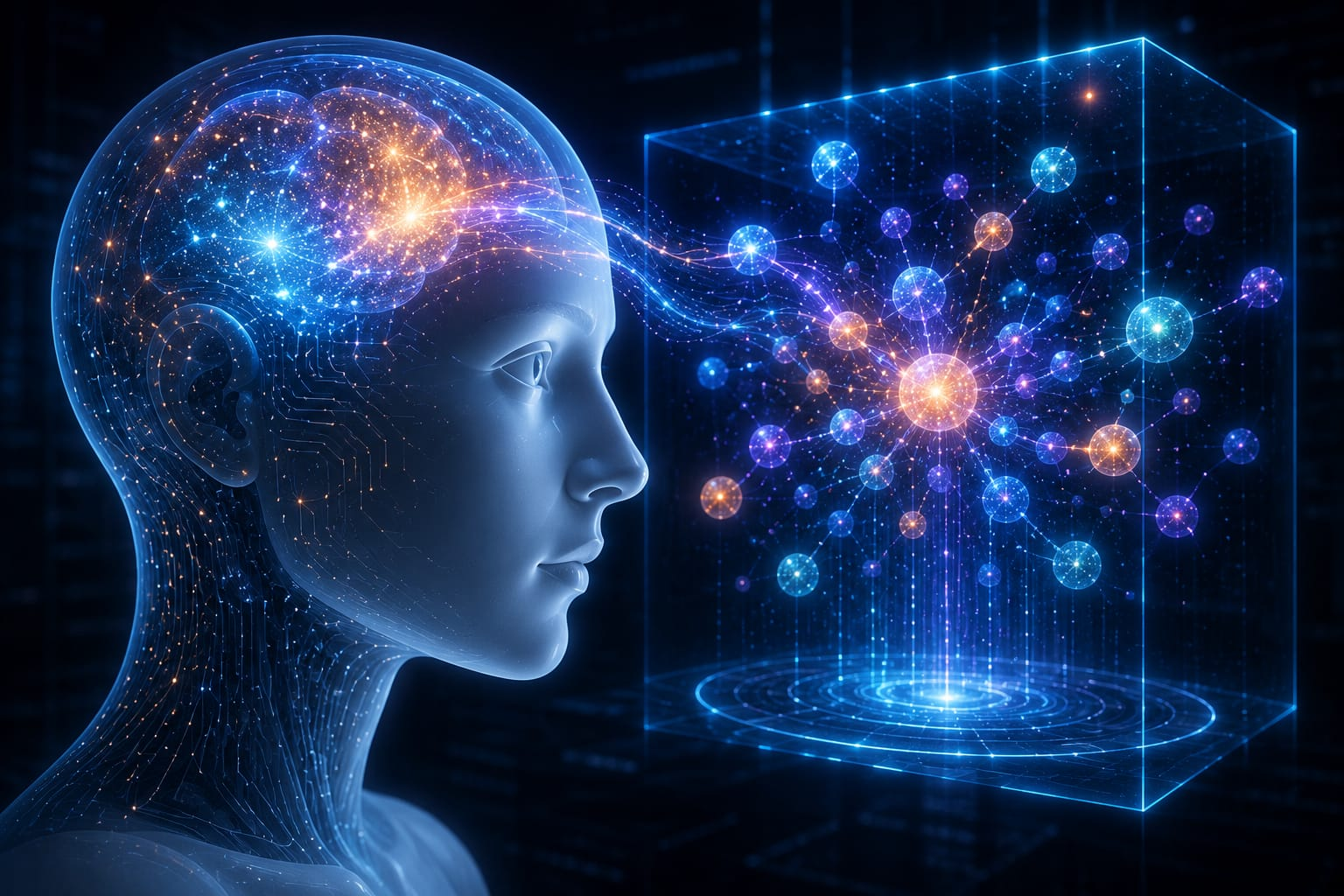
Anthropic claims that the AI model Claude has a kind of internal workspace that helps the model process and relate the information before providing answers. The workspace of the model is called J-space and is described by Anthropic as an internal space where the model is able to represent the information without expressing it in the answers.
The finding has been made thanks to the latest research paper, which has the title "Verbalizable Representations Form a Global Workspace in Language Models." The research paper has been published by Anthropic on July 6.
For further research purposes, Anthropic has also shared the methods behind the finding as an open-source code and made an interactive demo in collaboration with Neuronpedia.The scientists working for Anthropic� have identified an unknown inner mechanism of their AI called Claude that is known as J-space. The scientists believe that this system emerged automatically as a result of training and was not deliberately created or programmed by them.
The researchers claim that J-space is a specific inner mind where Claude thinks about various ideas before generating his responses.
What is J-Space?
J-Space is the name of a mathematical principle known as the Jacobian. It consists of internal neural patterns where each pattern corresponds to one word or concept. An activated pattern in J-space implies that Claude is thinking internally about that particular word or concept.
J-Space differs from the Chain of Thought reasoning in that it occurs internally within the AI without manifesting in the AI’s response text.
For instance, if the concept of “France” is active in J-Space, Claude will be able to quickly retrieve all the relevant information about the country such as its capital city, currency, or continent.
The research revealed that if Claude is restricted from accessing J-Space, it will still be capable of answering questions normally but will lack advanced reasoning skills. However, fundamental abilities, including speaking fluently, proper grammar usage, and retrieving basic information, won’t be impacted by such restrictions.
How did researchers investigate it?
This investigation was based on the concept of the Global Workspace Theory, which is a neuroscientific theory claiming that there are many specialized systems functioning in the brain.
In order to understand how Claude thinks, scientists have come up with a special technique known as J-lens (Jacobian Lens), which allows observing neural dynamics inside of Claude's head during his information processing.
Does this imply that Claude is conscious?
According to Anthropic, no. The company does not consider this to be proof that Claude is indeed conscious and feeling emotions like a human being.
It should be noted though that scientists say Claude's thoughts within J-space are "access-conscious" since they affect its reasoning and can be sometimes reported upon request. Whether or not it has anything to do with human consciousness is yet a matter of philosophy.
For now, Anthropic considers J-space to be a useful tool for research that can give information about Claude's inner thoughts.