
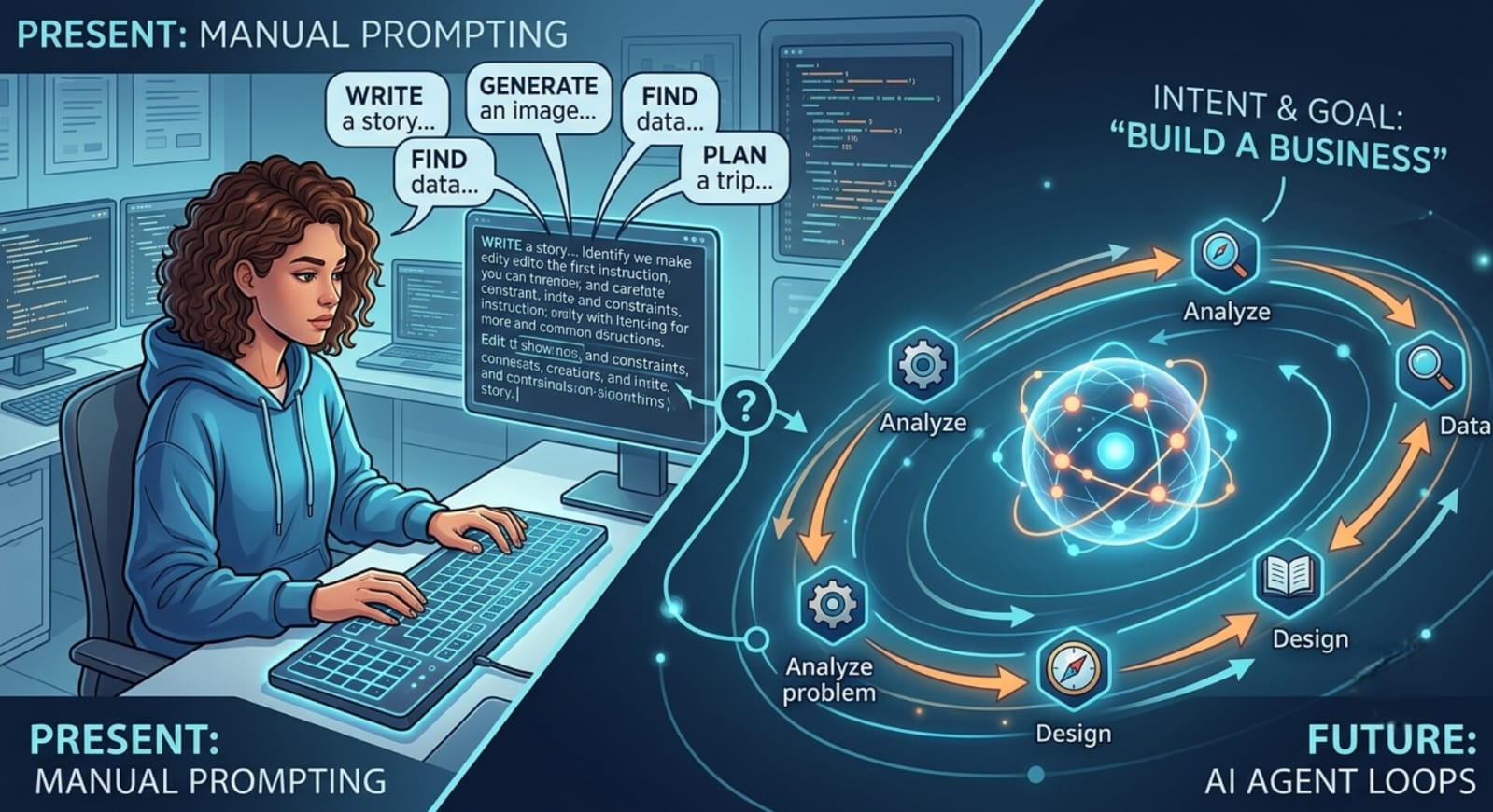
Ever since ChatGPT launched in 2022, the interaction between humans and AI has been dependent on one major process – users give prompts and contexts while AI generates responses. As a consequence, the skill of prompt engineering gained importance.
It was rather straightforward – better prompts usually resulted in better outcomes. For some time, prompting became the primary mode of communication with AI.
That said, the emergence of AI agents is altering this strategy. Not only do AI agents have the ability to perform tasks without constant human involvement, but they can also carry out those tasks without being prompted to do anything.Now, the next level of development is unfolding – loop engineering. The idea is to create systems in which AI agents strive towards a certain goal again and again, learning and improving until the job is done. In this case, users will not have to manually create prompts each time.
A number of prominent AI researchers even claim that loop engineering might be the future of interactions with artificial intelligence. Thus, Boris Cherny, the chief architect of Claude Code at Anthropic, confessed that he stopped writing prompts himself and started using loops of AI agents.
Another AI expert Peter Steinberger who is an engineer at OpenAI and the author of the OpenClaw project advised developers to stop prompting coding agents and to start working with loops.Likewise, Addy Osmani, Google Cloud’s director, has opined that loop engineering is taking up the job of humans as prompt writers. Rather than repeatedly telling the AI what to do, users can make systems in which the agents generate their own prompts and perform actions automatically.
With the development of AI technology, there is likely going to be a change in the future from writing prompts to designing intelligent systems for AI agents to keep working for us.